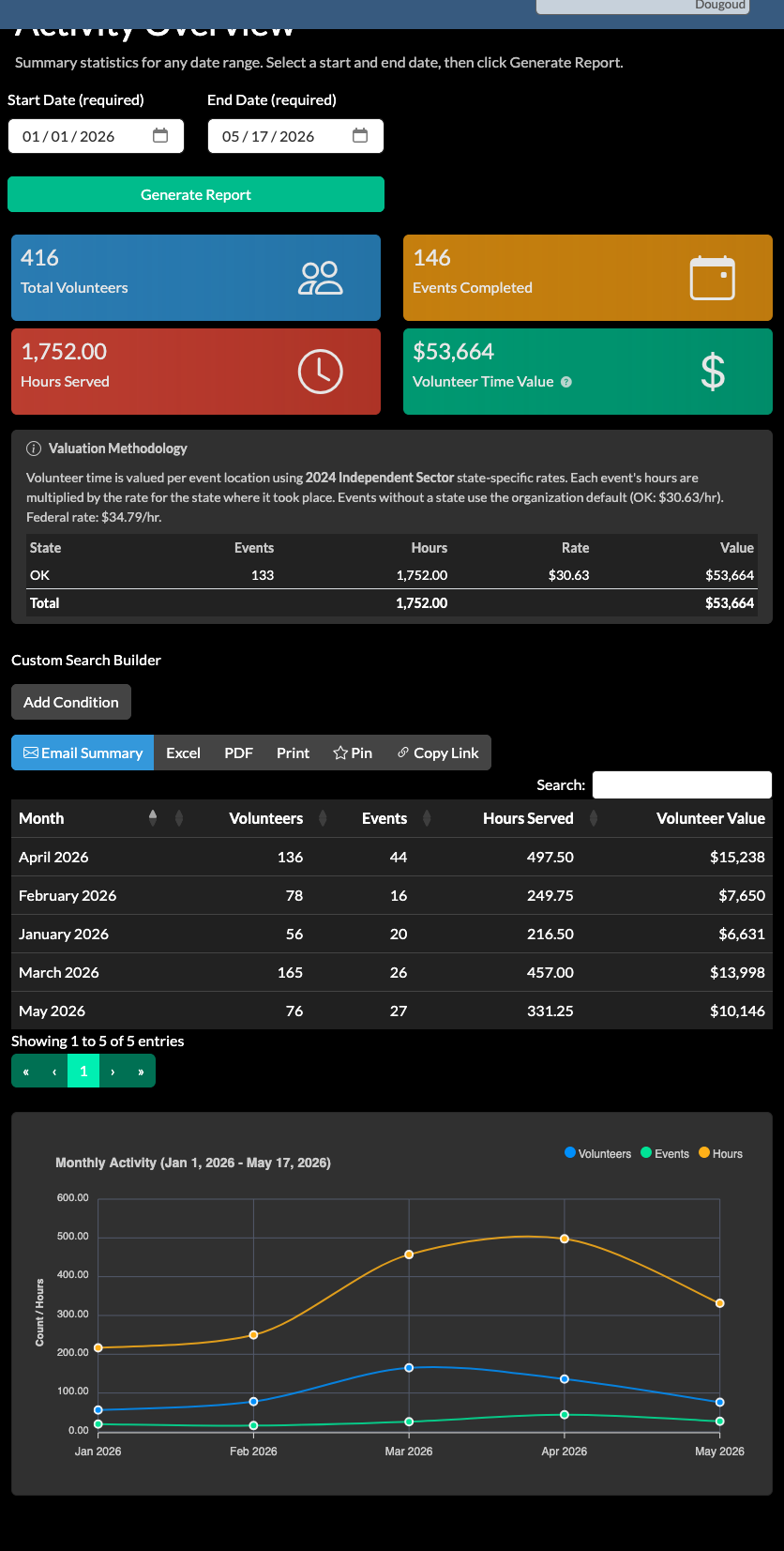
Serve.Love calculates volunteer time value automatically as hours are logged, using your state's Independent Sector rate. When the grant deadline hits, your number is already there.
When you're writing a grant application, funders want to see more than just your budget. They want to understand your organization's full capacity. One of the most overlooked ways to demonstrate impact is by calculating the dollar value of your volunteer hours.
This guide walks you through exactly how to do it, what rate to use, and how to present it in your applications.
The Standard: Independent Sector's Value of Volunteer Time
The most widely accepted method for valuing volunteer time comes from Independent Sector, a nonprofit leadership network that publishes an annual estimate of volunteer value.
For 2026, the national average value of a volunteer hour is $36.14, up from $34.79 the year before, a 3.9% increase (Independent Sector's most recent release, based on 2025 wage data).
This figure is based on Bureau of Labor Statistics data and represents the average hourly earnings of all production and nonsupervisory workers on private nonfarm payrolls, plus a 15% increase to estimate fringe benefits.
Independent Sector also publishes state-specific rates, which can be more accurate for local funders. For example:
- California: $41.75/hour
- Texas: $34.99/hour
- Oklahoma: $31.33/hour
- New York: $38.48/hour
Use the calculator above to see your state's rate, or check the complete rate table below.
The Basic Formula
Calculating volunteer value is straightforward:
Total Volunteer Hours × Hourly Rate = Volunteer Value
Example: Your organization logged 500 volunteer hours last year in Oklahoma.
500 hours × $30.63 = $15,315 in volunteer value
That's $15,315 in community support that didn't come from your operating budget, and it's a number funders understand.
Skilled Volunteer Hours: A Higher Value
Not all volunteer hours are equal. If a licensed attorney provides 10 hours of pro bono legal work, valuing that at $30/hour undersells the contribution significantly.
For skilled volunteers, you can use profession-specific rates based on Bureau of Labor Statistics wage data:
- Attorney: $75/hour
- Accountant/CPA: $45/hour
- Marketing professional: $40/hour
- IT specialist: $55/hour
- Medical professional: $65/hour
When reporting skilled volunteer hours, note the methodology: "Legal services valued at BLS median hourly rate for attorneys in [state]."
What Funders Want to See
When including volunteer value in grant applications, be specific and cite your methodology:
Good example:
"In 2026, 127 volunteers contributed 2,450 hours to our food distribution program, representing $75,044 in community investment (calculated using Independent Sector's 2026 state rate of $30.63/hour for Oklahoma). This volunteer support enabled us to serve 680 families while keeping operational costs at $12,000."
Weak example:
"We had lots of volunteers help out last year."
The difference? Numbers, methodology, and context. Use the calculator above to generate grant-ready language automatically.
Where to Use Volunteer Value Calculations
- Grant applications: Show organizational capacity and community buy-in
- Annual reports: Demonstrate total impact beyond dollars raised
- Board presentations: Help board members understand volunteer contributions
- Donor communications: Show how volunteer support multiplies donor dollars
- In-kind contribution reports: Some grants require in-kind matching; volunteer time often counts
Tracking Volunteer Hours Accurately
The challenge isn't the math: it's having accurate hour data in the first place.
If you're still using spreadsheets or paper sign-in sheets, you're likely:
- Missing hours when volunteers forget to log
- Spending staff time chasing down records
- Guessing at totals when grant deadlines hit
Modern volunteer management platforms solve this by tracking hours automatically, through mobile check-in, geofencing, or digital time logs, and calculating value in real-time.
Serve.Love, for example, displays volunteer time value directly on your dashboard using your state's 2026 Independent Sector rate, updated as hours are logged. When it's time to write that grant, the number is already there.
2026 Volunteer Hour Values by State
All rates from Independent Sector, published 2025. Based on Bureau of Labor Statistics data with 15% fringe benefit adjustment.
Source: Independent Sector, 2025 data (national average $36.14), released April 2026. Rates last verified by Serve.Love on August 21, 2026.
Key Takeaways
- Use Independent Sector's 2026 rate ($36.14 national, or your state rate) as the standard
- Calculate skilled volunteer hours at profession-specific rates when applicable
- Always cite your methodology in applications
- Present volunteer value with context: hours, volunteers, and what they accomplished
- Invest in accurate tracking so the data is there when you need it
Frequently Asked Questions
According to Independent Sector, the 2026 national average value of a volunteer hour is $36.14. This is a 3.9% increase over the prior year. State-specific rates range from $17.99/hour (Puerto Rico) to $54.77/hour (District of Columbia). Use the calculator above to find your state's exact rate.
Independent Sector (in partnership with the Do Good Institute at the University of Maryland) publishes an annual estimate based on Bureau of Labor Statistics data. The rate equals the average hourly earnings of all production and nonsupervisory workers on private nonfarm payrolls, plus a 15% adjustment to estimate fringe benefits. It is the most widely cited rate for valuing volunteer time in the nonprofit sector.
Yes. For volunteers providing professional services (legal, accounting, medical, IT), you can use profession-specific rates based on Bureau of Labor Statistics occupational wage data. Always cite your source, for example: "Legal services valued at BLS median hourly rate for attorneys." Use the skilled volunteer section in the calculator above to include these in your total.
In many cases, yes. Many federal, state, and foundation grants accept volunteer time as an in-kind contribution toward matching requirements. However, policies vary by funder. Always check the specific grant guidelines. When volunteer time is accepted as match, using Independent Sector's rate with clear documentation of hours and methodology is the safest approach.
Include the number of volunteers, total hours, the hourly rate used, the source (Independent Sector), and the year. Example: "127 volunteers contributed 2,450 hours, representing $75,044 in community investment (Independent Sector's 2026 Oklahoma rate of $30.63/hour)." The calculator above generates this language automatically. Just enter your numbers and copy.
Independent Sector updates rates annually, typically publishing new figures each April. The rate is tied to BLS wage data, so it generally increases year over year. For grant applications, use the rate for the year the volunteer hours were served. We update this calculator each year when new rates are released.
Resources
- Independent Sector: Value of Volunteer Time
- Bureau of Labor Statistics: Occupational Employment Statistics (for skilled rates)
Need help getting your volunteer hours organized? Let's talk about how Serve.Love can automate tracking and reporting for your next grant application.